The Research Pass I Run Before Starting Any New Channel
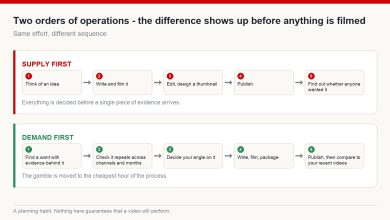
Most people start a channel in the same order. They think of an idea, they film it, they edit it, they publish it, and then they wait to see what happens. The waiting is the part that hurts, because by then every decision has already been made and there is nothing left to do but refresh the analytics page.
Creators who grow quickly tend to invert that order. They spend an uncomfortable amount of time looking at other people’s channels before they produce anything at all. Not to copy – to find out what the audience in that space has already decided it wants.
I have been making faceless videos since 2017, mostly for viewers in the US, the UK, Germany and Japan, and I still run the same research pass before every new channel and before every new run of videos on an existing one. It takes a couple of hours. It has saved me months.
Here is what that pass actually consists of, and what ends up in the notes.
A research pass is a block of time, not a mood
The thing that makes this work is treating it as a separate job with its own output. You are not “getting inspired”. You are producing a document: a page of observations you can hand to yourself two weeks later and still use.
Set a fixed block – two hours is plenty for a first pass – and open a blank sheet with columns before you open YouTube. If the sheet stays empty, the research did not happen, no matter how many videos you watched.
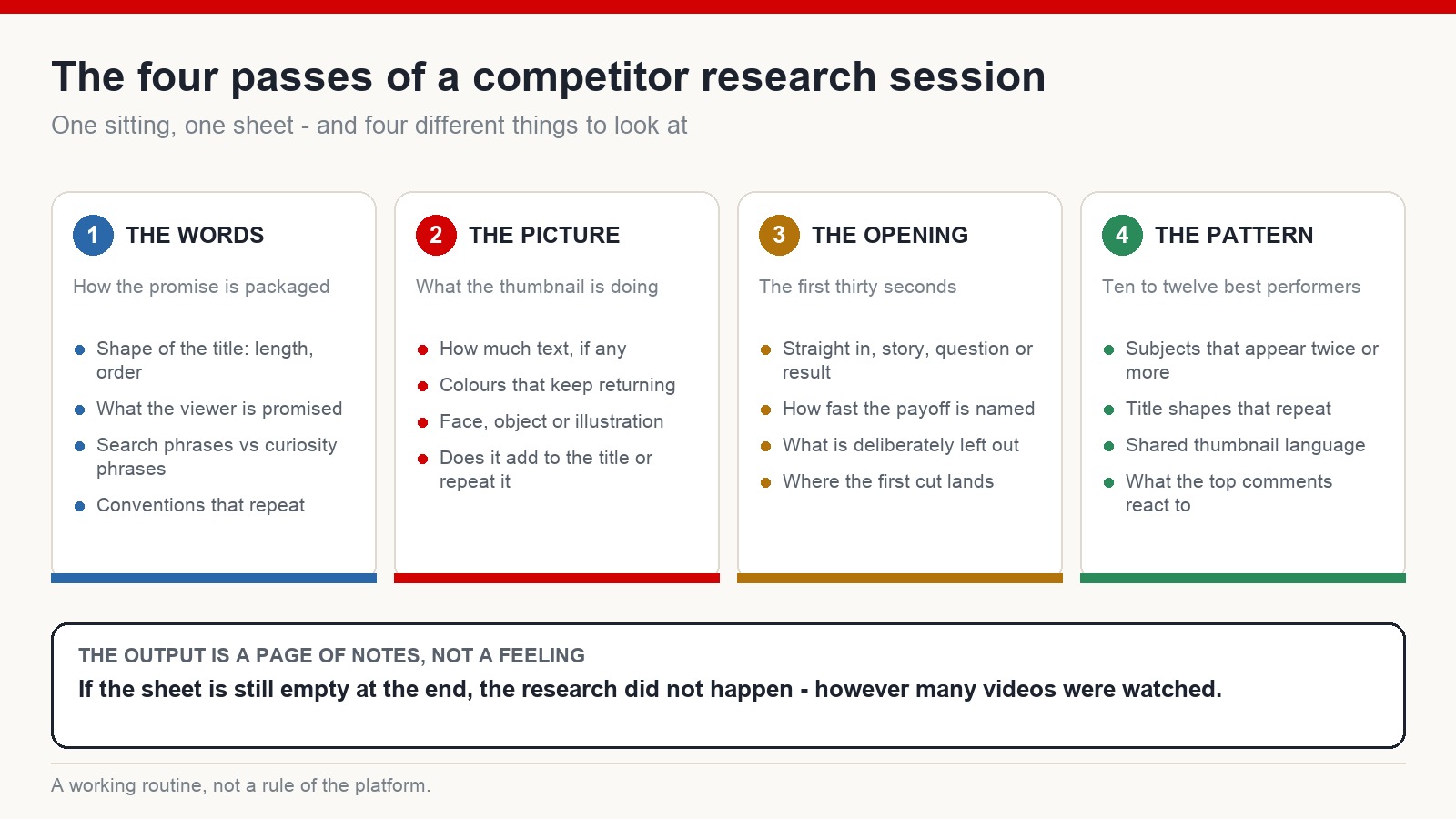
Four things go in the sheet: how the video is packaged in words, how it is packaged in a picture, how the opening is built, and what repeats across the channel’s best performers. Everything else is optional.
Pass one: how the promise is worded
Read titles as offers rather than as sentences. For each one, note the shape – how many words, where the subject sits, whether the phrasing is plain or dramatic – and then note the promise underneath it. What does the viewer expect to have after watching?
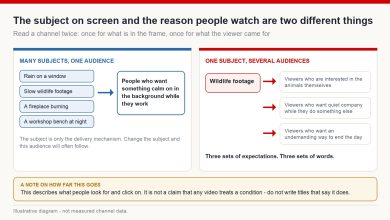
Two things are worth separating as you go. Some phrases are demand keywords: words a person would type into a search box because they already have the problem. Others are curiosity keywords: words nobody searches for, but that stop a scroll when they appear in a feed. Strong channels usually run a mix, and the ratio tells you a lot about where their traffic comes from.
After twenty or thirty titles, patterns start showing up on their own. That is the point of doing it in one sitting. One title is an anecdote; thirty titles is a convention, and conventions are what make a new channel read as native to a niche rather than as a tourist in it.
Pass two: what the thumbnail is doing
Thumbnails are where most beginners lose the click, and they are also the easiest thing to study, because you can judge one in a second – which is exactly how long a viewer gives it.
For each thumbnail, ask five questions. How many words are on it, if any? Which colours keep coming back across the channel? Is there a human face, an object, or an illustration? Where does the eye land first? And – the one people skip – does the thumbnail repeat the title, or add something the title does not say?
That last question is the difference between a pair that works and a pair that wastes half its space. The title and the image are two halves of one offer. If the title says what the video is and the thumbnail also says what the video is, you have said one thing twice.
What you are looking for across a niche is the one-frame idea: the single thought a viewer can absorb without reading. In some niches that is a face mid-reaction. In others it is a before-and-after split. In quiet niches it is a landscape with almost nothing on it. When several successful channels converge on the same one-frame idea, that is not laziness – it is a signal about what the audience expects to see.
Pass three: the first thirty seconds
Watch openings with the sound on and a notepad open, and stop at thirty seconds. Do not watch the whole video yet.
You will see roughly four moves, sometimes combined. Some videos walk straight into the subject with no preamble. Some open with a very short story. Some ask a question the viewer already has in their head. Some show the result first and then rewind to explain how it happened.
Whichever move they use, effective openings all resolve the same silent question fast: what do I get if I keep watching? Note how long that takes. If a channel consistently answers it inside ten seconds, that is a production rule you can adopt without copying a single sentence.
The other thing to note is what the opening does not do. In most well-run niches there is no long intro animation, no throat-clearing, no request to subscribe before anything has been delivered.
Pass four: the pattern across the best performers
This is the pass that matters most, and it is the one people rush.
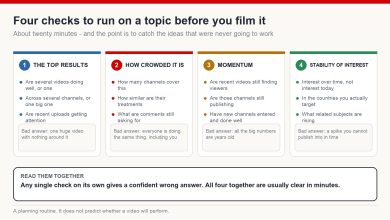
Do not study a single breakout video. A breakout can be a fluke, a lucky topic, or a moment that will not repeat. Instead, sort a channel by its most-watched videos and look at ten or twelve of them together.
Then write down five things: which subjects appear more than once, which title shapes repeat, what the thumbnails have in common, whether the videos are built the same way internally, and what the top comments say. Comments are underrated here – they tell you which part of the video people were actually reacting to, which is often not the part the creator thought was the centre.
When several strong videos share a structure, you are no longer looking at a result. You are looking at a strategy, and a strategy can be learned.
Learn direction from the leaders, learn execution from your peers
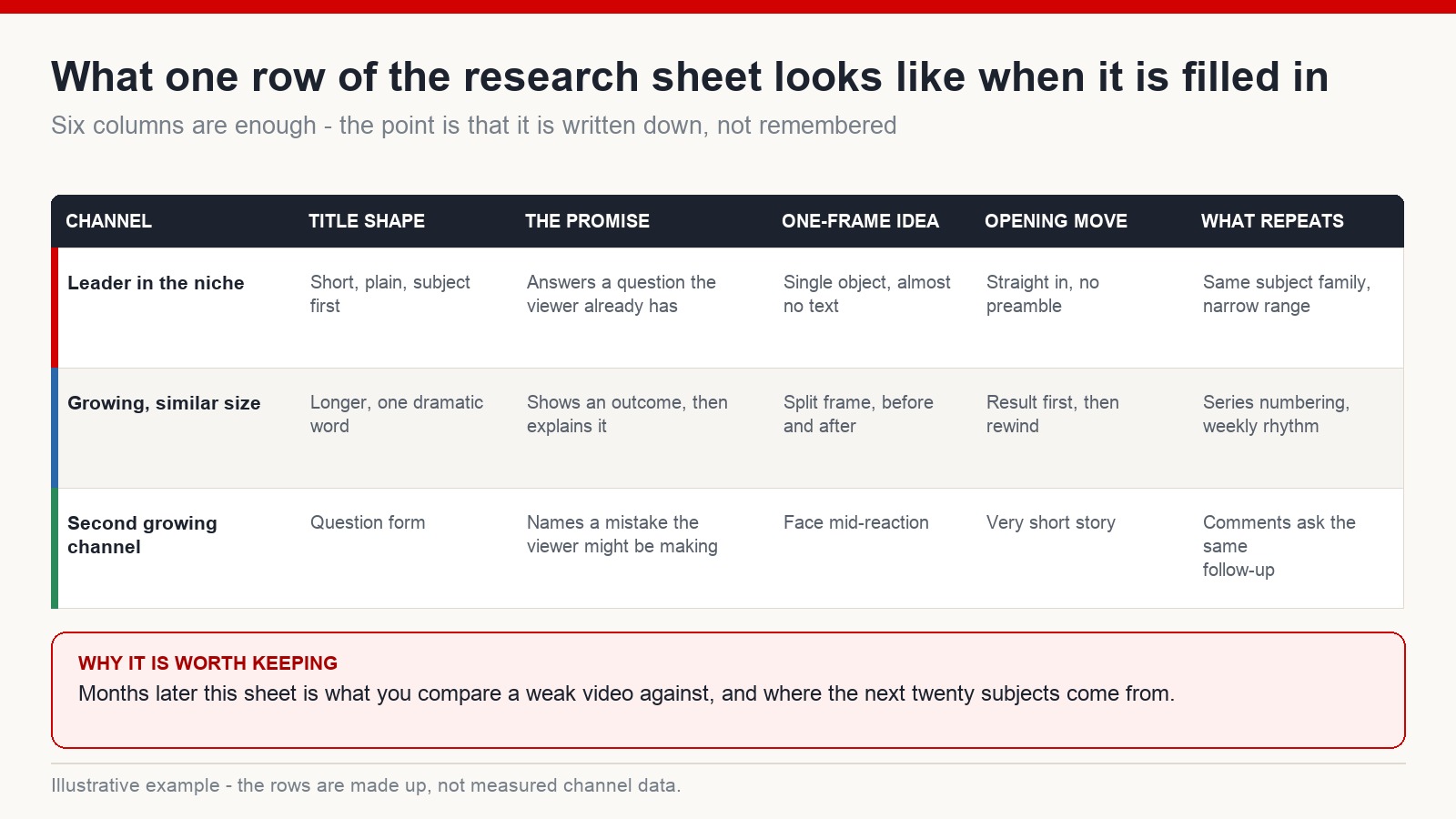
One practical split is worth building into the pass. Large, established channels are useful for direction: which subjects carry real demand, how a brand in this space is built, where the niche is heading. They are much less useful as a production model, because a team of six with a budget is not a template a person with a laptop can follow.
So take direction from them, and take execution from channels closer to your own size that are clearly growing – upload rhythm, video length, how they package without an established name to lean on. That is the version of the work you can actually reproduce this month.
The line between reading and copying
Copying is taking the thing itself: their script, their footage, their thumbnail with the colours changed. It is against the rules, and it is a dead end anyway, because a copy has no reason to exist next to the original.
Reading is taking the reasoning: why that phrase pulled people in, what the viewer wanted, why this framing got clicked when three similar ones did not. Nobody owns reasoning. It is simply visible if you look carefully enough, which is what the two hours are for.
What the sheet is worth later
The real return on a research pass shows up months afterwards. When a video underperforms, you have something to compare it against other than your mood. When you run out of ideas, the sheet has twenty subjects the audience has already voted for. When you hire or delegate, the conventions are written down instead of living in your head.
Nobody wins on YouTube by having an idea first. They win by understanding an audience better and executing more carefully than the version currently on offer. The research pass is where that understanding gets built, and it costs nothing but attention.
Frequently asked questions
How many channels should I look at before starting?
There is no required number, but the patterns only become trustworthy once you have several channels and a few dozen videos in front of you. Somewhere around five to ten channels in the same space is usually where repetition starts to appear.
Should I only study the biggest channels in the niche?
No. Big channels show you the shape of the market. Smaller channels that are visibly growing show you how the work is done with limited resources, which is the more useful lesson when you are starting.
Is it worth copying a title or thumbnail that clearly works?
Copy the structure and the psychology, not the wording or the artwork. A near-duplicate confuses viewers, competes with the original in search results, and gives you nothing to build a recognisable channel on.
How often should I repeat the research pass?
Once properly before you launch, then a lighter version every month or two. Niches drift – packaging conventions change, new channels appear, and the sheet goes stale faster than you would expect.
Does this work for faceless channels too?
It works particularly well for faceless channels, because everything you are studying – packaging, openings, structure – is independent of whether anyone appears on camera.
If you want the wider system this research pass sits inside, that is what I teach at mmoyoutube.com. Results vary, and YouTube changes its own rules regularly – the research habit is what keeps you adjusting rather than guessing.